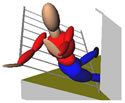
 Biomechanics is the application of mechanics to the interaction of biological systems with their external environment. When investigating an accident, biomechanical analysis can be used to reconstruct a victim's motion and relate it to his injuries. This can be applied in such diverse cases as determining the post-impact motion of occupants involved in an automobile accident, or calculating the impact force of an elevator door closing on a person's knee. A biomechanical analysis may be accomplished with simplified "stick figure" models or complex 3D computer simulation techniques.
Expertise
We have extensive experience in many aspects of biomechanics including:
- Head-form/windshield impact testing
- Head (HIC) and other Injury Criteria
- Computer simulations
- Body size & reach analysis
- Extensive Biomechanical Library
Questions Answered
Through scientific analysis, we can help you answer pertinent questions such as:
- Could the accident have happened the way the Plaintiff describes?
- Did the victim trip into the railing or was she pushed hard?
- What level of injury could be expected from such an impact?
Case Examples
Fall from Swing:
A child was swinging on a plastic swing seat when he fell off and suffered a severe head injury. The defense claimed that he must have been standing or otherwise misusing the swing when the accident occurred. We used a biomechanical simulation to demonstrate that the low coefficient of friction (COF) between the swing seat and the child's shorts could have resulted in the fall he described and that an alternate seat design with a higher COF would have prevented the accident.
Fall Over Balcony Railing:
A woman was injured when she struck a balcony railing which gave way, allowing her to fall to the ground 10 feet below. She claimed she was walking at a normal speed when she tripped and fell into the railing. Our biomechanical analysis of the impact and fall based on the balcony height and her rest position, determined that she was moving much faster than a normal walking speed when she struck the railing. This result supported evidence that she was pushed, and helped the case settle rapidly.
Kristopher J. Seluga, PE, is a Mechanical Engineering, Accident Reconstruction, Biomechanics, and Safety Expert with over 20 years of experience. He received his Bachelor's and Master's degrees from the Mechanical Engineering department at MIT where he worked on the development of novel three-dimensional printing technologies. Mr. Seluga is also a licensed Professional Engineer in New York and Connecticut, and has served as a member of the ANSI engineering committee for the Z130.1 and Z135 standards for golf cars and PTV's. His research interests and peer reviewed publications span the topics of Motor Vehicle Dynamics, Product Safety, and Biomechanics.
©Copyright - All Rights Reserved
DO NOT REPRODUCE WITHOUT WRITTEN PERMISSION BY AUTHOR.