On July 24th, 2013, Aero-Environmental received a management request for a Noise Health Hazard Evaluation (HHE) from Greg Meyer, SSF Site Manager with SBM. The HHE request asked Aero-Environmental to assess the noise levels experienced by workers in the Cage Wash Areas of Buildings 14 and 48 at Pharmaceutical Co, South San Francisco facility. On July 31st, 2013, Jorge Vizcaino, CIH 9814 with Aero-Environmental Consulting measured noise exposures levels for workers in these cage wash areas.
Noise Exposures to Cage Wash Area Workers
Veterinary hospital workers, animal shelter employees, workers at facilities that board animals, and biotechnology companies that conduct research on animals are potentially exposed to excessive occupational noise levels from different work activities.
Personal Noise Monitoring at this pharmaceutical company had not been conducted in these cage wash areas since 2004. Since that time there have been some changes with the operation of these buildings. Pharmaceutical also adopted stricter criteria for exposure limits.
Facility Description
These two Pharmaceutical research buildings are house in South San Francisco. The buildings consist of administrative, research support areas, and a large portion of each building that house the majority of rodents and animal research. The rodents, rabbits, and other small animals are housed in small cages in several areas of the building. All of these cages go through a daily cleaning cycle.
These buildings were not accessible to the public unless accompanied by a staff member. There were also other common areas associated with these animal holding facilities such as common hallways, break rooms, and research support offices.
Cage Washing Activities
The cage wash workers reported to work between 6:00 a.m. and 8:00 a.m. and left work between 3:00 p.m. and 3:30 p.m. Workers got two 10- minute morning breaks and one half-hour long lunch break. The main cage washing work activities were feeding the cages, building the cages, moving cages from one location to another, washing the cages, preparing the water, rotating the food around, sending the cages to a tunnel, preparing the feeders, janitorial, and moving the animals.
1.0 ASSESSMENT
Noise Assessment
On July 31, 2013, 14 employees who work in the cage wash areas of Buildings 14 and 48 contributed 14 full-shift, personal noise measures. 3M®Edge eg5 Noise Dosimeters were worn by the cage wash workers while they performed their daily activities. The noise dosimeters were attached to the wearer's shirt/coverall at a point midway between the ear and the outside of the shoulder. A windscreen provided by the dosimeter manufacturer was placed over the microphone during recordings. At the end of the workday, the dosimeter was removed and paused to stop the data collection. The information stored in the dosimeters was downloaded to a personal computer for interpretation with Detection Management Software for Windows® computer software. The dosimeters were calibrated before and after the measurement periods according to the manufacturer's instructions.
2.0 RESULTS AND DISCUSSION
Noise Assessment
Fourteen cage wash area workers provided 14 personal noise dosimetry measures over a 1-day evaluation. Seven of the 14 measures exceed the daily allowable noise dose of 100% as calculated by the NIOSH/TLV criterion. Eleven measures also exceeded the NIOSH and Pharmaceutical Action Level (AL). The NIOSH and Pharmaceutical PEL was exceeded in seven employees. The full-shift TWA values for comparison with the NIOSH REL ranged from75 dBA to 89 dBA. Table 1 summarizes these results.
Pharmaceutical requires all of the employees working in the positions that exceeded the criteria for hearing conservation to be, or continue to be, included in a Hearing Conservation Program (HCP). Additionally, when exposure measurements exceed an 8-hour TWA of 85 dBA at the 85 dB threshold, and equivalently a dose of 100%, the employer is required to utilize feasible administrative or engineering controls to reduce noise exposure. If such controls fail to reduce sound levels to within levels listed in Pharmaceutical's Hearing Conservation Program, hearing protection shall be provided and used to reduce sound levels to within those listed in the aforementioned program.
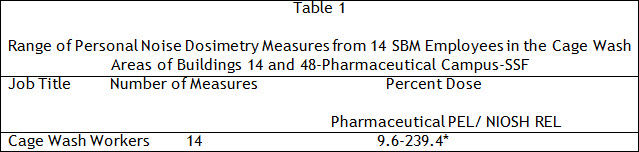
* NIOSH REL/Pharmaceutical reached or exceeded 7 times
Personal noise levels exceeding the NIOSH REL/Pharmaceutical PEL were not surprising for Building 14 because (1)the constant cage washing/cage operation activities in these areas will result in noise reverberation, and (2) the large volume of cages that had to be cleaned, moved, prepared, and passed through the tunnel meant employees in Building 14 spent long hours cleaning the cages, thus increasing their duration of exposure. However, the personal noise levels at Building 48 were significantly lower when compared to Building 14. The two buildings were comparable with respect to cage washing work activities but differed in volume of cages that had to be cleaned and prepared. Building 48 had a much smaller volume of cages, resulting in less noise.
Noise control strategies in cage wash areas are complicated. Sound-absorbing materials such as spray-on foam and fibrous mineral wool, which are usually used in the industry and other indoor settings to reduce noise exposures, are not appropriate in cage wash areas because they are difficult to clean while maintaining dryness in order to avoid mold and mildew. One approach may be to use sound-absorbing material on surfaces that do not need to be cleaned routinely such as ceilings. Acoustical ceiling tiles that are waterproof and washable can be installed to reduce noise (Carter 2007). In addition, floors can be covered with rubber mats to absorb sound from the movement of cages or operation of equipment, and to reduce noise from cages hitting on hard (metal) surfaces. These approaches may offer some reduction in noise levels, but do not eliminate the direct noise path from the cage washing activities to the worker. A noise survey should be conducted after any engineering controls (like the ones mentioned above) are in place to determine if personal noise exposures to workers are reduced.
3.0 CONCLUSIONS
This evaluation showed that cage wash workers with SBM/Pharmaceutical Animal Center Vivarian Cage Wash areas were exposed to hazardous noise levels.
4.0 RECOMMENDATIONS
Based on the observations and findings of this evaluation, the following recommendations are offered to better protect the hearing of workers at Pharmaceutical Cage Wash Areas of Buildings 14 and 48.
- Establish (or continue to implement) a hearing loss prevention program (Hearing Conservation Program) for the cage wash workers. The basic elements of the program should, at a minimum, meet the requirements for a hearing conservation program as outlined in the OSHA hearing conservation amendment (29 CFR 1910.95). Other sources for defining effective hearing conservation programs are also available (Suter 2002: NIOSH 1996; Royster JD and Royster LH 1990).
- Wear hearing protection devices (ear muffs or ear plugs) when working in cage wash areas. Train employees on the proper fit, selection, and maintenance of hearing protectors. For example, ear plugs should be deeply inserted into ear canals, and cushions on ear muffs should not be cracked or creased, and the head bands not sprung.