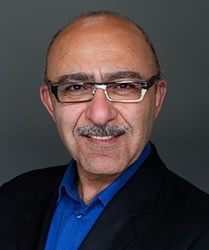
Dr. Kazerooni is a Professor of Mechanical Engineering at the University of California, Berkeley, where he also serves as the Director of the Berkeley Robotics and Human Engineering Laboratory. With over 35 years of experience in mechanical engineering and a doctorate from MIT, he is a leading expert in automated machinery, including robotics, medical devices, ergonomics and human-machine systems, wearable and assistive devices, exoskeleton systems, as well as orthotic and prosthetic systems. He is the inventor of more than 200 US and International patents, over 80% of which have been licensed, and has been inducted into the U.S. National Academy of Inventors.
In addition to his academic teaching and research, Dr. Kazerooni is an active entrepreneur. In 2005, he founded Ekso Bionics (eksobionics.com), which became a publicly traded company in 2014 and now supplies the Ekso medical exoskeleton to rehabilitation centers worldwide. He later founded suitX (suitx.com), a venture capital-, industry-, and government-funded company providing industrial and medical exoskeletons. suitX was acquired in late 2021 by Ottobock, a medical device company in Europe.
Litigation Support - Dr. Kazerooni has been deposed and testified in various Intellectual Property cases. His services include thorough examination and reporting, depositions, and trial testimony as needed.
Areas of Expertise:
- automated machinery
- robotics
- medical devices
- ergonomics and human-machine systems
- wearable and assistive devices
- exoskeleton systems
- orthotic and prosthetic systems
- intelligent assist devices
- control algorithm
By: Dr. Homayoon Kazerooni
Recently, with the progress of computers, robot manipulators have obtained some abilities of perception and judgmenl. However, it st ill remains a dream that robots have the same or more nexible intelligence than humans. In the mean time, the physical ability of a robot manipulmor is superior in cases such as carrying heavy loads.
By: Dr. Homayoon Kazerooni
Many places in the world are too rugged or enclosed for vehicles to access. Even today, material transport to such areas is limited to manual labor and beasts of burden.
By: Dr. Homayoon Kazerooni
The primary Objective of the Berkeley lower Extremity Exoskeleton (BLEEX) Project at the University of California, Berkeley is to develop fundamental technologies associated with the design and control of energetically autonomous lower extremity exoskeletons that augment human strength and endurance during locomotion.