1. INTRODUCTION
Commissioning and start-up follow the construction phase of typical engineering, procurement, and construction (EPC) projects. During commissioning, newly installed equipment and systems are brought online, integrated, and tested against the design requirements (typically without the introduction of chemicals, in the case of chemical processing plants). In the subsequent start-up, chemicals are introduced, and the system is brought online to facilitate performance testing, followed by turn-over to the permanent operations organization. The commissioning and performance tests are designed to demonstrate that the installed system satisfies the design requirements and the performance test requirements as specified in the contract.
This article provides a high-level overview of typical commissioning and start-up activities and their associated key considerations. The provision of complete, detailed descriptions of all commissioning and start-up activities for multiple project types and industries is beyond the scope of this article.
Many studies have shown that successful start-ups and subsequent operation of newly built systems have direct relationships to the quality of the commissioning work.1 It has been reported that the cost of starting up new chemical processing facilities can be as much as 8% to 12% of the capital project costs and that good start-up planning and execution can save 1% to 3% of the total project cost.2 However, industry benchmarking data indicate that commissioning and start-up efforts and performance often fall below expectations.3 Clearly, commissioning and start-up are critical project activities that require appropriate focus and resource allocation to ensure overall project success.
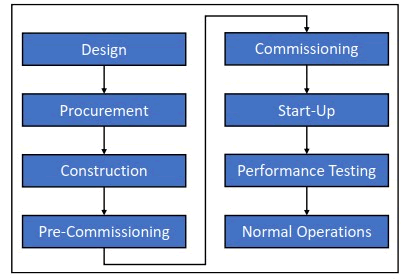
Commissioning and start-up comprise several project phases, as shown below in Figure 1, and as follows:4
- Pre-commissioning: typically performed by the contractor, includes de-energized verification and testing including flushing of piping and motor bumps to verify proper rotation direction;
- Commissioning: typically performed by the owner, includes energized testing of equipment and integrated systems, typically using air and/or water instead of actual process chemicals;
- Start-up: typically performed by the owner, includes integrated system start-up, addition of chemicals, and ramp up to steady state; and
- Performance testing: typically performed by the owner, includes execution of performance tests designed to demonstrate that performance of the fully integrated system satisfies all contract performance requirements.
Figure 1: Phases of a Typical EPC Project
Although the entities that typically perform the various commissioning and start-up activities are listed above, in some cases the contractor may perform the commissioning and performance testing, or the owner may contract the services of an independent third-party commissioning consultant to perform these activities. Therefore, contract documents should clearly state the party responsible for executing each project phase to avoid ambiguity.
The definition of the mechanical completion milestone, at which point the construction organization hands over the system to the commissioning organization, can be project specific, occurring either prior to5 or after6 the pre-commissioning phase. Therefore, contract documents should clearly define the criteria for achieving the mechanical completion milestone. The ready for start-up milestone is typically achieved upon successful completion of the commissioning phase (prior to the start-up phase).7
In some cases, depending on the specific industry and geographical location, there may be commissioning and start-up codes, specifications, and/or guidelines published by various governmental agencies and/or professional organizations that should be adhered to and comprehended in the commissioning and start-up planning and procedures.8 For example, ASME PTC 40-1991 provides performance test codes for flue gas desulfurization (FGD) units,9 the U.S. Department of Energy (DOE) provides guidelines for the commissioning of nuclear plants,10 and Jarløv11 and the U.S. Environmental Protection Agency (EPA)12 summarize general commissioning guidelines and requirements for buildings. Where applicable, parties should include reference to such documents in contract requirements. Further discussion of such industry and location-specific commissioning and start-up specifications is beyond the scope of this article.
The remainder of this article first discusses general considerations for commissioning and start-up planning in Section 2. The execution of the various commissioning and start-up phases is then discussed in Section 3.
2. GENERAL CONSIDERATIONS
2.1 Responsible Parties
Responsibility for the various commissioning and start-up planning and execution tasks is generally project-dependent and can lie with any one of several potential organizations. The responsible organizations can include the EPC contractor’s commissioning team, the owner’s commissioning team, an owner engineer’s commissioning team, a third-party commissioning consultant contracted by the owner, the owner’s permanent operations and maintenance (O&M) team, or a combination of these organizations. Typically, the contractor’s commissioning team is expected to provide on-site support during activities for which the owner is responsible.13
To avoid ambiguity, ownership of commissioning and start-up planning and execution tasks should be determined early in a project so that the EPC contract can clearly define contractor-responsible tasks and deliverables.14 Regardless of the organization(s) responsible for the planning and execution of the various activities, the commissioning organization will ultimately turn over the system to the owner’s permanent O&M organization for ongoing O&M, including asset and spares management.15 The turn-over process typically includes provision of O&M manuals and training manuals, as well as training of the owner’s O&M personnel. Therefore, the owner’s O&M organization should ideally be involved in the execution of commissioning and start-up activities to facilitate appropriate training and develop expertise with the O&M of the new system.
2.2 Planning
Commissioning and start-up planning activities typically start early in a project and continue throughout various project phases to fully prepare the commissioning organization to take over ownership of system components at mechanical completion and proceed directly to the commissioning and start-up phases. These planning activities typically include:
- development of commissioning organizational charts and hiring of personnel, if required;16
- development of commissioning schedules including determination of the order in which various new equipment will be commissioned;17
- development of documentation including O&M manuals, training materials, and test plans and procedures;18 and
- procurement of necessary materials to support commissioning and start-up activities, including spares19 and chemicals.
Detailed discussions of the scheduling of these planning activities are available elsewhere and are outside the scope of this article.20
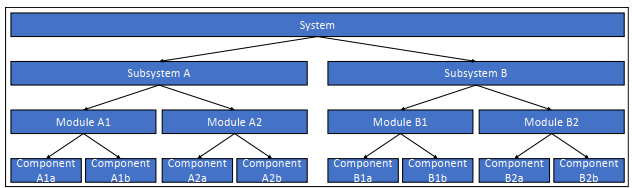
To facilitate detailed commissioning and start-up planning, the system should first be systemized.21 The system hierarchy should be defined from a systems engineering perspective, as in the example shown below in Figure 2, and clear delineations between various components, modules, and sub- systems should be shown on the P&IDs. This systemization allows for a bottoms-up approach to commissioning, where individual pieces of equipment are first commissioned at the component level and then integrated together and commissioned at higher and higher levels of the hierarchy to ultimately facilitate commissioning and start-up of the facility at the system level. If a project was specified and/or designed based on systems engineering principles, this hierarchy may be similar to the work breakdown structure (WBS) for the project.
Figure 2: Typical System Hierarchy
Once systemization is complete, the order of commissioning priority for the various components, modules, and subsystems can be determined. Typically, utilities such as power, water, and compressed air, and other global modules, such as control systems, wet laboratories, and reagent delivery systems, are commissioned first because they need to be available to facilitate the commissioning and start-up of the primary processing equipment.22 The commissioning prioritization sequence should be defined early enough in a project so that it can be reflected in the turn-over prioritization shown in the construction schedule.23
The documentation deliverables should be completed early enough in a project to allow for owner review and/or approval before they are required for execution of commissioning and start-up activities and/or subsequent ongoing operations. These deliverables typically include but are not limited to:24
- the O&M manual, which should include all safety considerations and requirements such as the result of process hazard reviews, material safety data sheets (MSDS), definition of lock-out/tag-out (LOTO) points and confined spaces as well as standard operating procedures (SOPs) for nominal and off-nominal operation;
- the process control narrative;
- all required O&M training documents; and
- procedures for tests and special operations to be performed during pre-commissioning, commissioning, start-up, and performance testing activities.
All testing and operational procedures should include detailed step-by-step instructions and should reference P&ID tags for specific equipment, instrumentation, and controllers to remove any possibility of ambiguity. Additionally, the documentation should encompass all modes of operation. All operational modes as well as the transition between the various operational modes should be fully tested during commissioning and start-up.
3. SITE EXECUTION
This section discusses execution of the various activities in each of the commissioning and start- up project phases: pre-commissioning, commissioning, start-up, and performance testing. In addition to descriptions of the activities typically performed during each of the phases, insights into general best practices are provided based on the author’s experienceThis section discusses execution of the various activities in each of the commissioning and start- up project phases: pre-commissioning, commissioning, start-up, and performance testing. In addition to descriptions of the activities typically performed during each of the phases, insights into general best practices are provided based on the author’s experience...
Conintue Reading....Download PDF with footnotes, figures, tables, and references.